
TL;DR
Can I have multiple Amazon accounts?
- Buyers: Yes.
- Sellers: Yes, but only with a legitimate business need and full structural separation between entities.
- 2026 Update: Pre-approval is no longer always required, but documented legal and operational separation remains non-negotiable.
- The verdict: You can operate multiple accounts on Amazon only if each operates as a genuinely distinct business entity. Opening secondary stores as suspension backups or metrics workarounds will lead to permanent bans.
Can I Have Multiple Amazon Accounts?
The rules governing multiple accounts depend heavily on whether you are buying or selling on the platform.
Buyer Accounts
For shoppers, having more than one account is common and permissible. Amazon’s Privacy Notice states that a customer might have more than one account when different email addresses or mobile numbers have been used. Users often separate personal shopping from business purchases.
If your goal is sharing Prime shipping or digital content, the compliant route is setting up an Amazon Household, which supports:
- 2 adults, each with their own separate account and payment method
- Up to 4 teens (13–17) with managed, supervised accounts
- Up to 4 children with profiles under the adults
Creating duplicate buyer accounts to manipulate product reviews, abuse promotional referral codes, or bypass purchase quantity limits violates the Terms of Service and will trigger account closures.
Seller Accounts
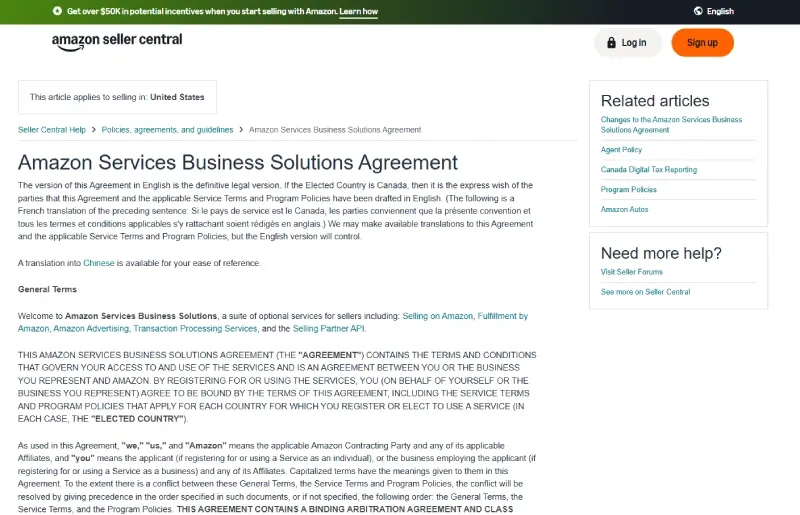
The default framework defined in the Amazon Services Business Solutions Agreement states that a seller should maintain only one Seller Central account per region. However, an exception exists: sellers who possess a legitimate business justification can operate multiple Amazon seller accounts.
The #1 Misunderstanding
Many merchants assume that risk diversification—protecting revenue in case one store faces a policy violation—is a valid reason for a second storefront. It is not. Amazon expects distinct business infrastructure, which means separate legal entities, tax IDs, and bank accounts.
The question is never “why do you want a second account?” It’s “is this a genuinely separate business that happens to also sell on Amazon?”
✅ Accepted: A separate LLC selling pet supplies while your first company sells camera gear is structural.
❌ Rejected: A second account holding the same catalog “just in case” is policy evasion, not business separation.
Amazon Multiple Accounts Policy Explained
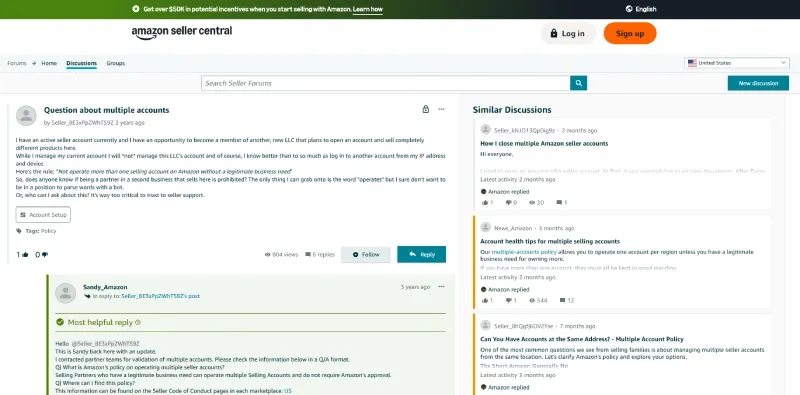
The Official Rule and 2026 Changes
Historically, the Amazon multiple seller accounts policy required sellers to open a support ticket and wait for explicit permission before launching a second store. As of 2026, Amazon’s policy permits a second account as long as you have a legitimate business need and your accounts are in good standing — you no longer always have to file a ticket and wait for sign-off.
This is a trap dressed as a convenience. Removing the approval step did not remove the requirement; it removed the paper trail that used to protect you. Filing for written approval is still the smart move, because if your accounts are ever flagged, documented, Amazon-acknowledged business need is the strongest evidence you have.
What “Legitimate Business Need” Actually Means
Based on official Amazon guidance and seller enforcement patterns:
✅ Generally accepted:
- Separate legal entities — two distinct LLCs or corporations with their own EINs
- Distinct brands with no product overlap (skincare vs. fishing gear)
- Different categories requiring separate operational handling
- Manufacturer vs. reseller roles for the same products
- Agency-managed client accounts, operating accounts for separate clients
- Regional expansion that requires separate account structure
❌ Routinely rejected:
- A backup account in case the main one is suspended
- “Starting fresh” after a ban or policy strike
- Buy Box manipulation — running two accounts on the same product
- Avoiding performance metrics by shifting volume to a cleaner account
- Duplicate stores selling the same catalog under a second name
The pattern is simple: separation that exists for business reasons is fine; separation that exists to defeat Amazon’s enforcement or competition rules is not.
Buyer vs. Seller Rules Comparison
| Parameter | Buyer Accounts | Seller Accounts |
|---|---|---|
| Default Stance | Multiple generally permitted | One per region unless justified |
| Data Overlap | Allowed (same address/IP) | Strictly monitored and penalized |
| Primary Risk | Promo abuse, review manipulation | Algorithmic account linking |
| Penalty | Account closure | Global ban, frozen funds (90+ days) |
Mini Case Examples
Approved scenario: A merchant operates an electronics brand under “TechGear LLC” and launches a new organic skincare line under “PureGlow LLC.” They use distinct EINs, separate business checking accounts, and dedicated teams.
Rejected scenario: A seller lists phone cases on “Store A” and creates “Store B” using their spouse’s name and credit card to sell the exact same inventory, attempting to occupy twice the ad space.
Gray area: An individual buys an existing successful Amazon business but fails to migrate the network and device environment. Logging into the acquired store from the same physical device used for their personal, previously-suspended store triggers an immediate association.
How Amazon Detects Linked Accounts

Operating multiple accounts on Amazon requires understanding how anti-fraud systems track digital identities. Amazon’s machine learning models evaluate hundreds of data points to map relationships between users.
What is Browser Fingerprint Consistency?
Browser fingerprint consistency refers to the logical alignment of your device’s hardware and software data. When you visit a website, your browser exposes parameters like your User-Agent, screen resolution, timezone, and operating system.
If these data points contradict each other—for example, if your User-Agent claims you are on Windows 11 but your TCP/IP stack reveals Linux characteristics—security systems flag the environment as artificially spoofed.
1. Network Signals
Platform algorithms continuously map IP addresses and subnet patterns. Basic commercial VPNs are entirely ineffective for account separation because their ASN / ISP Detection reveals them as datacenter IP ranges, which carry low trust scores. You can verify your connection type and ASN information using tools like IPQualityScoreIPQualityScore or IPinfo.
Two leak vectors make VPNs especially risky:
- WebRTC IP leak — even with a VPN active, the browser’s WebRTC stack can reveal your real IP through ICE candidate gathering unless properly blocked at the browser level
- DNS leak — if DNS queries route to your ISP instead of through the proxy, the resolved ISP won’t match your proxy’s location
2. Browser & Device Fingerprinting
Every device leaves a unique mathematical trace. Browser fingerprinting is a technique that combines dozens of parameters into a near-unique signature. Amazon reads your:
- Canvas Fingerprint — the browser renders hidden graphics, and tiny rendering differences across GPU, driver, and font stacks produce a pixel hash
- WebGL Metadata —
WEBGL_debug_renderer_infoexposes the actual GPU model and vendor - AudioContext — processing an audio signal through the Web Audio API yields output values that differ by OS audio stack
- Font enumeration — the installed font set reflects your specific software environment
- User-Agent and UA Client Hints — these must agree with each other
- Timezone consistency —
Intl.DateTimeFormat().resolvedOptions().timeZonemust match the geolocation of your IP
3. Cookies & Sessions
Standard browser profiles share persistent data. LocalStorage, IndexedDB, and cross-site tracking cookies allow platforms to recognize returning devices even if the IP address changes. This is why profile isolation — fully separate cookie jars, local storage, IndexedDB, and cache per account — is foundational rather than optional.
Modern tracking systems also use sophisticated techniques like Evercookie that can restore identifiers from multiple storage locations even after manual deletion.
4. Business Data Overlap
The most heavily weighted signals are hard business inputs:
- Identical bank accounts or deposit methods
- Overlapping credit cards
- Shared EIN/tax IDs
- Duplicated physical addresses
- Identical product catalogs (ASINs)
A single shared bank account will link two seller accounts no matter how perfect your technical isolation is.
The “Frankenstein Problem”
Many sellers attempt to cobble together a safe environment by buying cheap proxies from Vendor A and pairing them with a free anti-detect tool from Vendor B. This creates IP Geolocation Mismatch.
If your IP address locates you in Texas, but your browser’s timezone reflects London, the system identifies the manipulation immediately. This disjointed setup is the primary trigger for account suspensions.
The fix isn’t a better proxy or a better browser — it’s making every layer agree: IP location, timezone, locale, DNS, and browser fingerprint must tell one consistent story.
Why Sellers Use Multiple Accounts
| Motivation | Status | Explanation |
|---|---|---|
| Brand Separation | ✅ Legitimate | Distinct LLCs targeting completely different demographics |
| Agency Client Management | ✅ Legitimate | Managing separate storefronts for independent third-party clients |
| Business Acquisition | ✅ Legitimate | Purchasing an established FBA business to run alongside an existing one |
| Risk Diversification | ❌ Prohibited | Operating redundant stores as a safety net against policy violations |
| Buy Box Dominance | ❌ Prohibited | Listing the same products across two stores to monopolize the product page |
Reality check — sort your reason before you act:
- ✅ Good: Separate legal entities and brands; agency-managed client accounts; genuine category separation
- ⚠️ Gray: “Risk diversification” that’s really one business wearing two hats
- ❌ Bad: A suspension backup; “starting fresh” after a strike; two accounts on the same product
The Real Risks & Consequences
The Amazon multiple accounts policy is enforced ruthlessly by automated systems.
Immediate Impact
When a link is detected between a healthy store and a suspended store:
- All linked accounts are suspended at once — the clean account goes down with the rest
- Funds are frozen, typically held for 90+ days while Amazon reviews
- FBA inventory is held in Amazon’s warehouses; you may pay storage on stock you can’t sell
- Listings are removed, erasing ranking and review history
Long-Term Impact
- A confirmed violation can become a permanent ban, not a temporary suspension
- Amazon blacklists the entity and identity signals — the EIN, bank account, address, and device fingerprints
- Future accounts are auto-flagged — any new account that touches a blacklisted data point can be linked and closed on creation
Financial-Impact Example
Consider a merchant generating $40,000 monthly with roughly $60,000 in FBA inventory. A linkage suspension can mean:
- ~$40,000 in payable balance frozen for 90+ days
- $60,000 in inventory locked in warehouses (still accruing storage fees)
- Lost sales velocity that tanks rankings even after reinstatement
The realistic exposure isn’t a fine — it’s six figures of working capital and several months of momentum.
How to Manage Multiple Amazon Accounts Safely
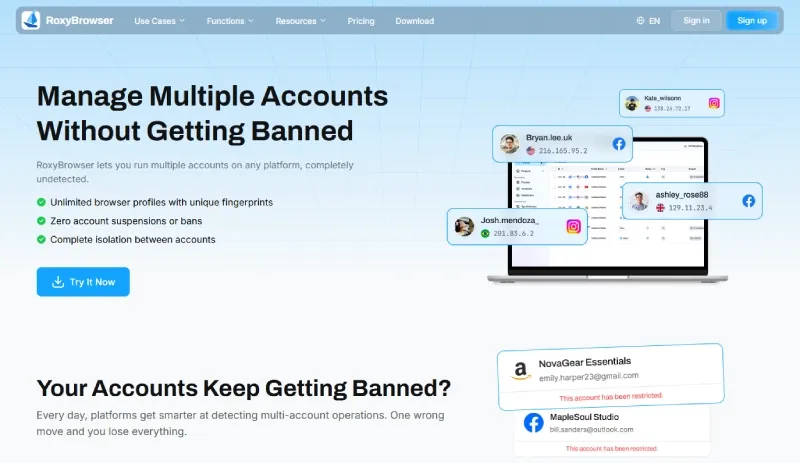
To compliantly manage multiple accounts, you must implement strict isolation protocols that satisfy platform security metrics.
The 4-Layer Isolation Framework
Think of account separation as four stacked layers. Each one has to hold independently.
Layer A: Legal / Business
This is the foundation, and it can’t be faked with software. Each account needs:
- Its own legal entity (LLC or corporation)
- Its own EIN/tax ID
- Its own business bank account and card
- Its own physical/return address
- Its own contact details
Layer B: Network
Each account needs a dedicated residential or ISP proxy, fixed to that account permanently, with an IP that matches the account’s stated location. Not a rotating proxy, not a shared datacenter IP, and not one proxy reused across accounts. IP consistency and geolocation alignment are the goals.
Layer C: Browser / Device
Each account needs a unique, internally consistent browser fingerprint and fully isolated cookies and storage. The fingerprint must be self-consistent and stable over time, because a fingerprint that changes every session is more suspicious than one that stays fixed.
Layer D: Behavioral
Beyond the technical setup, the accounts should look like different businesses operating: distinct catalogs, different suppliers, different team members logging in, and different operating rhythms.
Why Standard Browsers and VPNs Fail
A VPN masks your IP address but does nothing to change your device’s hardware parameters. When you switch a VPN from New York to California, your WebGL rendering hash and Canvas signature remain identical. The platform simply sees the exact same computer moving across the country.
To genuinely separate the device layer when you run multiple Amazon accounts, you need an antidetect browser: a tool that gives each account its own isolated profile with a distinct, consistent fingerprint and its own bound proxy.
Integrating Professional Infrastructure
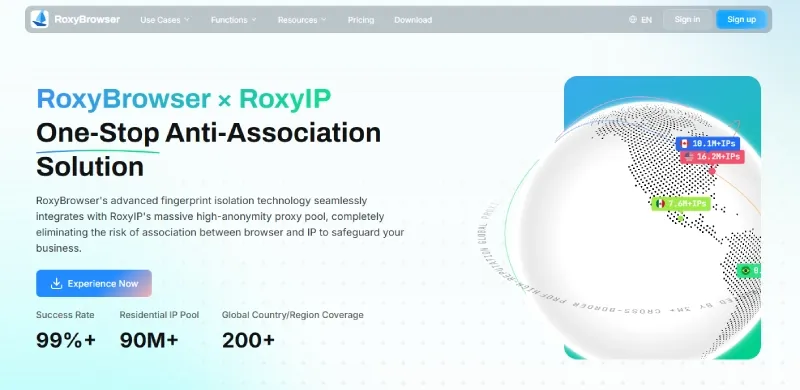
Executing this framework effectively requires specialized infrastructure. RoxyBrowser provides an all-in-one environment built for managing high-value commercial accounts, pairing kernel-level fingerprint isolation with its own built-in proxy network so you don’t have to source the two layers separately.
Key capabilities:
-
Built-in Premium IP Network: RoxyBrowser runs its own residential proxy store of 90M+ clean native nodes covering 200+ countries and regions, with dedicated lines for social media and cross-border e-commerce backed by 1-on-1 operational support. With the built-in proxy bound to a profile, going from selecting an IP to a ready-to-use environment takes about 30 seconds — IP, timezone, and locale aligned in one step, which is what actually solves the “Frankenstein Problem.”
-
Deep Hardware Camouflage: Built on the Chromium 149 Core, it works at the browser kernel to customize 210+ underlying hardware parameters — Canvas, AudioContext, and even mobile-specific traits like battery and Bluetooth — so each profile behaves as a genuinely independent device. The goal is a stable, internally consistent environment engineered for high, durable long-term account survival, able to stand up to top-tier fingerprint checks like Pixelscan.
-
AI Agent Automation: As the first anti-association platform to ship a real AI Agent, RoxyBrowser lets you skip rigid RPA scripts entirely. A single natural-language command is interpreted by the AI to drive 100+ physical browser windows concurrently with zero code, with full MCP protocol and custom Skills support so it slots into your existing toolchain.
-
Enterprise Collaboration: Built for studio-scale teams, it offers unlimited sub-accounts, granular permission tiers, and one-second environment-template sync, supporting 100+ people collaborating across borders. You can share environments and isolate passwords securely while keeping per-person audit logs — without ever exposing account credentials.
Technical Tool Comparison
| Feature | RoxyBrowser | Multilogin | AdsPower | GoLogin | Incogniton |
|---|---|---|---|---|---|
| Core Architecture | Chromium 149 Core | Custom Chromium | Custom Chromium | Custom Chromium | Custom Chromium |
| Built-in Proxies | Native 90M+ IP store (200+ regions) | Bring your own | Built-in + BYO | Limited built-in | Bring your own |
| Fingerprint Approach | Core-level, 210+ params | Core-level | Core-level | Core-level | Core-level |
| Account Survival | Engineered for high, stable survival | High | High | Moderate | Moderate |
| AI Automation | Native AI Agent + MCP + Skills | Limited | Scripted / API | Limited | Limited |
| Team Collaboration | Unlimited sub-accounts + audit logs | Advanced (enterprise) | Solid | Basic | Basic |
| Pricing Model | All-inclusive | Premium enterprise pricing | Per-profile tiers | Free + paid tiers | Free + paid tiers |
Setup Walkthrough (4 Phases)
Phase 1 — Build the business layer. Before touching any software, register the separate entity, obtain its EIN, open a dedicated business bank account and card, and secure a distinct business address and phone number. If layer A isn’t real, nothing downstream matters.
Phase 2 — Create an isolated profile. In your antidetect browser, create a new profile for the account and assign it a dedicated proxy. In RoxyBrowser, this is a one-click native proxy in the country that matches your business location — IP, timezone, and locale sync together automatically.
Phase 3 — Verify before you log in. Never register or sign in until you’ve confirmed the environment is clean. Open a detection site such as BrowserLeaks or whoer.net inside the profile and check:
- The IP matches the intended country
- There’s no WebRTC leak exposing your real IP
- The browser timezone matches the IP’s location
Phase 4 — Register and operate normally. Set up each account in line with Amazon’s policies, and run it like the independent business it is. Build out listings at a natural pace and keep clear records of each entity’s separate operations — that documentation is what protects you if your accounts are ever reviewed.
Golden Rules & Common Mistakes
5 Golden Rules of Account Management
- One browser profile strictly equals one seller account
- Never utilize overlapping credit cards or bank deposit accounts
- Do not list identical ASINs across multiple storefronts
- Never access two different accounts from the same unmasked local Wi-Fi
- Maintain one dedicated static proxy per account for its entire lifecycle
Fatal Mistakes
| ❌ Fatal Mistake | ✅ Correct Approach |
|---|---|
| Logging in via public Wi-Fi or airport networks | Accessing the store strictly through a static, isolated proxy profile |
| Using a relative’s details to open a “fresh” store after a ban | Legally establishing a new entity and isolating the entire digital footprint |
| Sharing a customer service team that logs into multiple accounts from one PC | Utilizing team collaboration features to share isolated browser sessions securely |
| Managing two accounts from the same home/office IP | Bind a dedicated residential/ISP proxy to each account |
| Mixing a browser from one vendor with proxies from another | Use one platform where proxy and fingerprint are unified |
| Reusing one bank account or card “to keep it simple” | Separate bank account and card per legal entity |
Special Scenarios
International Marketplaces: North American accounts (US, CA, MX) utilize a Unified Account structure. European marketplaces are similarly grouped. Expanding to Europe from the US does not violate the single-account rule. Use Amazon’s official unified-account tools rather than disconnected logins.
Agencies and Virtual Assistants: Account management agencies must utilize delegated access via Amazon’s User Permissions system, or deploy isolated anti-detect profiles for each client to prevent cross-contamination of client assets. Each client account needs its own clean environment with its own bound proxy and fingerprint.
Acquisitions: Upon purchasing an FBA brand, keep the newly acquired account’s digital environment completely isolated for at least 6+ months while transitioning business details to prevent algorithmic flags. An abrupt merge looks exactly like one operator running two accounts.
Conclusion
The answer to “can I have multiple Amazon accounts” is yes, but the buyer-side and seller-side rules are not the same.
Policy compliance matters more than software. The safest operational standard is scaling a single, highly optimized store. If legitimate expansion requires operating multiple Amazon seller accounts, full structural and digital separation is mandatory.
Best: One well-optimized account, when you don’t have a real reason for more.
Good: Multiple Amazon accounts with genuine, documented separation across all four layers.
Prohibited: Any account whose purpose is to circumvent a ban, dodge metrics, or duplicate a store.
Implementing specialized infrastructure and rigid isolation protocols ensures your business entities remain distinct, compliant, and protected from automated linking algorithms. Tools support compliance; the business reason has to be yours.


