
Modern anti-bot systems have evolved from parameter-level detection to environment-level detection. Next-generation solutions like Cloudflare Bot Management and Akamai Bot Manager collect a wide range of signals—including TLS handshake characteristics, HTTP/2 frame parameters, WebGL rendering hashes, audio-context floating-point deviations, and the full Navigator property set—scoring behavior using machine-learning models rather than relying on single-rule matching.
Against this backdrop, various antidetect browsers built on the same Chromium fork remain highly uniform at the lower layers—sharing identical TLS cipher-suite ordering, HTTP/2 negotiation parameters, and JS-engine behavior—no matter how their surface-level parameters are configured. In large-scale, multi-account operations, this underlying homogeneity creates systemic correlation risk that parameter tweaking alone cannot eliminate.
To address this, RoxyBrowser has introduced a Firefox (Gecko) engine and launched the RoxyFirefox product line, forming a dual-engine architecture alongside the existing RoxyChrome. The two are fully independent at the rendering, network stack, and JS execution layers, eliminating shared low-level fingerprint traits across accounts at the root.

Core Technical Implementation
1. Engine-Level Environment Modification
Some anti-correlation solutions on the market override the return values of front-end APIs (such as navigator and screen) through JavaScript-layer injection (JS hooks). This approach has a well-known bypass: detection scripts can obtain an untampered, native API object inside an isolated iframe and compare it against the values returned in the main frame (a Native API Integrity Check), exposing the manipulation.
RoxyFirefox modifies environment parameters at the C++ level of the Gecko engine, directly altering the return logic of hardware and platform APIs within the WebIDL binding layer. Regardless of the access path the JavaScript layer uses to read a property, every value originates from the same underlying implementation. The result is full logical self-consistency, leaving no “clean native value” for a script to compare against.
2. Graphics and Audio Fingerprint Isolation
Canvas / WebGL
Firefox and Chromium differ fundamentally in their graphics pipelines: shader compilation behavior, floating-point precision handling, and driver call paths are all distinct, producing systematic differences in pixel rendering for the same scene. Building on this, RoxyFirefox injects stable, per-profile Canvas noise that differs from one profile to the next—each profile produces a consistent hash across sessions, while different profiles exhibit a natural statistical distribution.
AudioContext Fingerprinting
A common audio-fingerprinting technique renders a specific frequency signal through OfflineAudioContext and reads the minute deviations in the floating-point sample buffer caused by hardware and software differences. RoxyFirefox reproduces Firefox’s native audio-rendering floating-point behavior at a low level. Combined with a differentiated codec support matrix, this ensures the audio fingerprint matches the statistical distribution of a genuine Firefox environment.
3. Network-Layer Fingerprint Reconstruction
TLS Fingerprint Alignment (JA3 / JA4)
The cipher-suite ordering, extension list and its ordering, and elliptic-curve parameters within the TLS ClientHello together form a hashable TLS fingerprint. Firefox and Chromium have markedly different TLS fingerprints; therefore, a session that declares Firefox in its UA while presenting a Chromium-style handshake will immediately be flagged as anomalous. RoxyFirefox aligns its JA3 and JA4 values at the network-stack level with those of the latest stable Firefox release, ensuring perfect consistency between the network-layer signature and the declared UA.
HTTP/2 Frame Parameter Emulation
HTTP/2 fingerprinting primarily captures the parameter values and ordering in the SETTINGS frame (including default values and declaration order of fields like HEADER_TABLE_SIZE, MAX_CONCURRENT_STREAMS, and INITIAL_WINDOW_SIZE), along with the initial increment of the WINDOW_UPDATE frame. WAFs like Akamai identify clients by comparing these against a library of known browser HTTP/2 signatures. RoxyFirefox faithfully reproduces Firefox’s HTTP/2 negotiation parameters and frame order, effortlessly passing protocol-layer fingerprint checks.
WebRTC Leak Protection
RoxyFirefox disables the exposure of local network interfaces during ICE candidate gathering at the engine level, preventing real IP addresses from leaking around proxy configurations via the WebRTC STUN mechanism.
4. Enhanced Tracking Protection (ETP) Integration
Firefox’s native Enhanced Tracking Protection blocks requests to known third-party tracking domains at the network layer and restricts cross-site cookie access using a built-in tracker list. RoxyFirefox retains and enables this capability. On top of profile isolation, it further reduces the signal surface for cross-account correlation at the network-request level.
When to Use Each Engine
| Engine | Recommended Scenarios | Technical Rationale |
|---|---|---|
| RoxyChrome | Established, stable accounts; workflows with high compatibility requirements. | The Chromium engine offers broader Web API support, making it well-suited to business scenarios dependent on specific browser behaviors. |
| RoxyFirefox | Cold-starting new accounts; large-scale social media account management; accounts requiring heterogeneous isolation from Chrome environments. | The Firefox engine shares no low-level fingerprint traits with Chromium. Native ETP reduces the tracking signal surface, and some platforms apply different risk-scoring weights to Firefox traffic versus Chrome. |
Both engines run independently within the same client, do not share profiles, and can be assigned flexibly by account type—with no migration of existing environments required.
What the Dual-Engine Architecture Delivers
-
Eliminates Low-Level Correlation Risk: RoxyChrome and RoxyFirefox are fully independent at the rendering, network stack, and JS execution layers. When a platform’s anti-bot system cross-references a cluster of accounts, it finds no shared low-level fingerprint traits to correlate, cutting off the path to bulk correlation caused by engine homogeneity at its source.
-
Eliminates JS Hook Detection Risk: All environment modifications are implemented at the C++ level, leaving no hook-injection traces in the JavaScript layer. Detection scripts cannot expose the environment through a Native API Integrity Check, removing the inherent detectability of hook-based approaches.
-
Consistency Between Network and Application Layers: The TLS fingerprint, HTTP/2 frame parameters, and User-Agent declaration are perfectly aligned. This eliminates the common protocol-layer contradiction of “a UA claiming Firefox but a handshake looking like Chromium,” effectively countering WAF protocol-layer fingerprinting.
-
Isolation of Existing and New-Account Risk: The dual-engine architecture lets you assign environments by account lifecycle and risk profile: stable, established accounts stay unchanged in the RoxyChrome environment, while new-account cold-starts and high-risk bulk accounts run independently in the RoxyFirefox environment. The two environments operate in parallel without interference, isolating risk exposure by design.
-
Reuses Firefox’s Native Security Capabilities: As a native component of the Gecko engine, ETP is built into RoxyFirefox. It blocks third-party tracking requests at the network layer with no additional configuration required—working in tandem with profile isolation to form a layered defense.
Get Started with Dual Engines
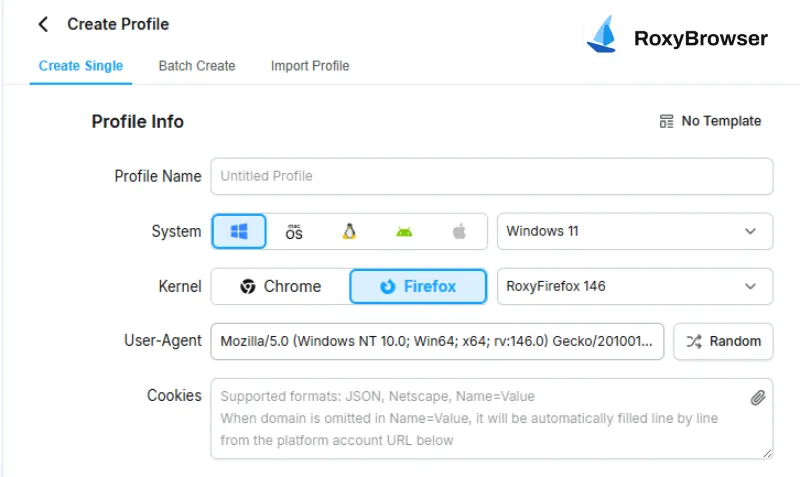
The RoxyFirefox engine is now officially available. Log in to the Roxy client and select the Firefox engine when creating a new profile to get started.
Existing RoxyChrome users require no migration—both engines run in parallel within the same client, managed independently and without interference.


