
TL;DR
NetNut-related proxy infrastructure is now a supply-chain risk, not just a service issue.
If performance dropped, unstable sessions, more CAPTCHAs, and rising retries may already be hurting your workflows.
When reviewing netnut alternatives, prioritize source transparency, stability, and real-world testing over price.
If you’re still using NetNut, or using another proxy provider built on the same upstream traffic, you’ve probably already noticed something is off.
The first sign usually isn’t a total outage. It’s lower success rates, more CAPTCHAs, weaker session stability, and proxy connections that suddenly stop behaving like they used to. Flows that were stable a few weeks ago now need repeated retries. Most teams blame their scraper, browser fingerprint, or target-site defenses first.
But this time, the problem may not be in your execution layer at all. It may be in the proxy supply chain itself.
That’s what makes this more than a routine service disruption. It exposes one of the biggest blind spots in the residential proxy market: are you actually buying a sustainable, compliant traffic source, or are you buying an upstream network that only looks strong until it gets exposed?
If you’re comparing netnut alternatives right now, price and pool size should not be your first filters anymore. What matters first is where the IPs come from, whether they’re still clean, whether sessions remain stable, and whether that supply can support a real business over time.
This article focuses on proxy sourcing risk, operational impact, and how to evaluate a stronger NetNut alternative. It is not advice on bypassing platform rules or using proxies for illegal activity.
What Actually Happened to NetNut?
This did not start as a normal maintenance issue or regional performance fluctuation.
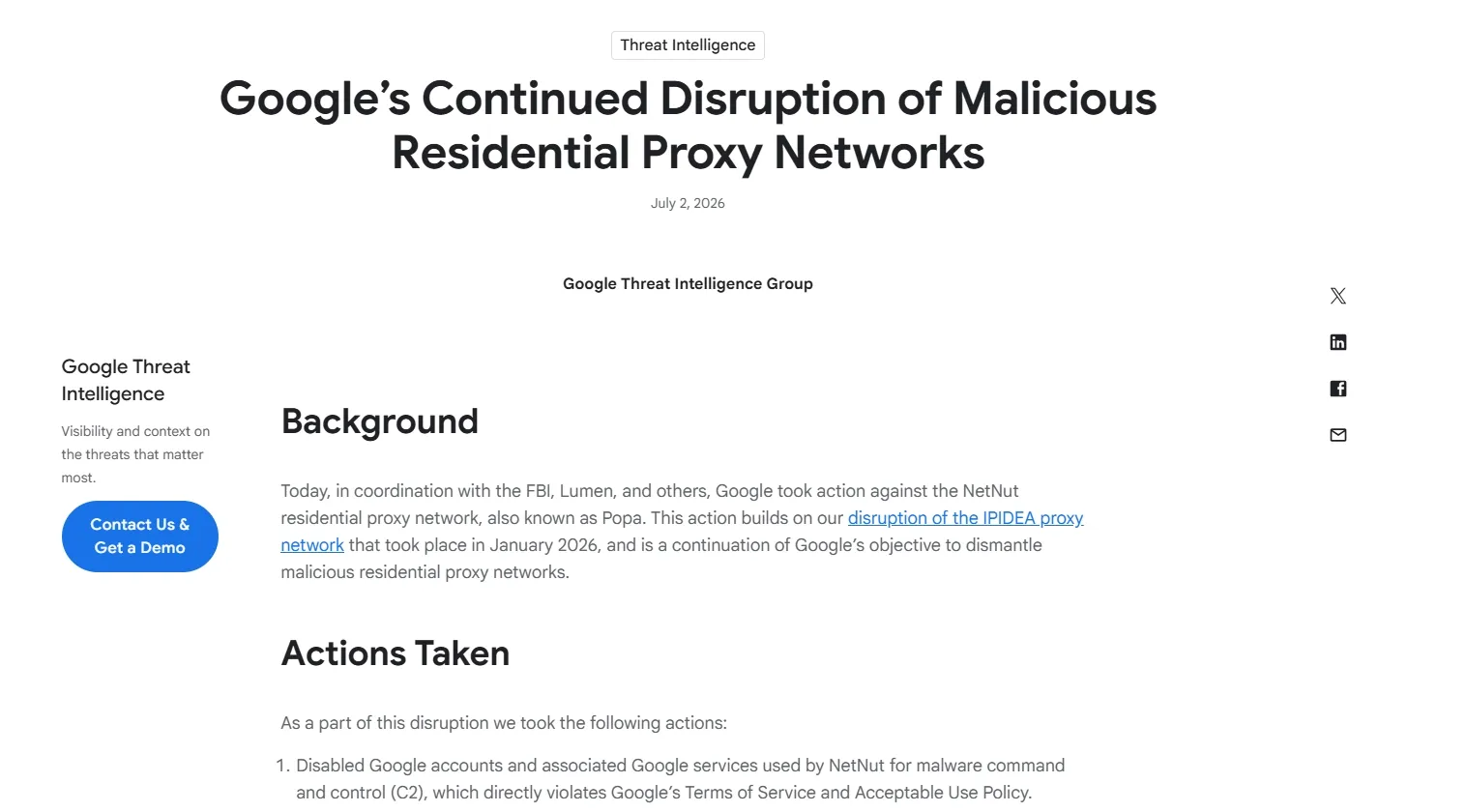
On July 2, 2026, Google Threat Intelligence said Google worked with the FBI, Lumen, and other partners to take action against a residential proxy network it associated with Popa. The report also said Google disabled related control accounts, used Google Play Protect against apps that integrated the relevant SDK, and shared technical intelligence with other platforms and law-enforcement agencies.
Earlier KrebsOnSecurity reporting had already described a massive residential proxy operation sourcing exit nodes from household devices and TV-box software distribution, often without users realizing their home connection had effectively become part of a proxy network.
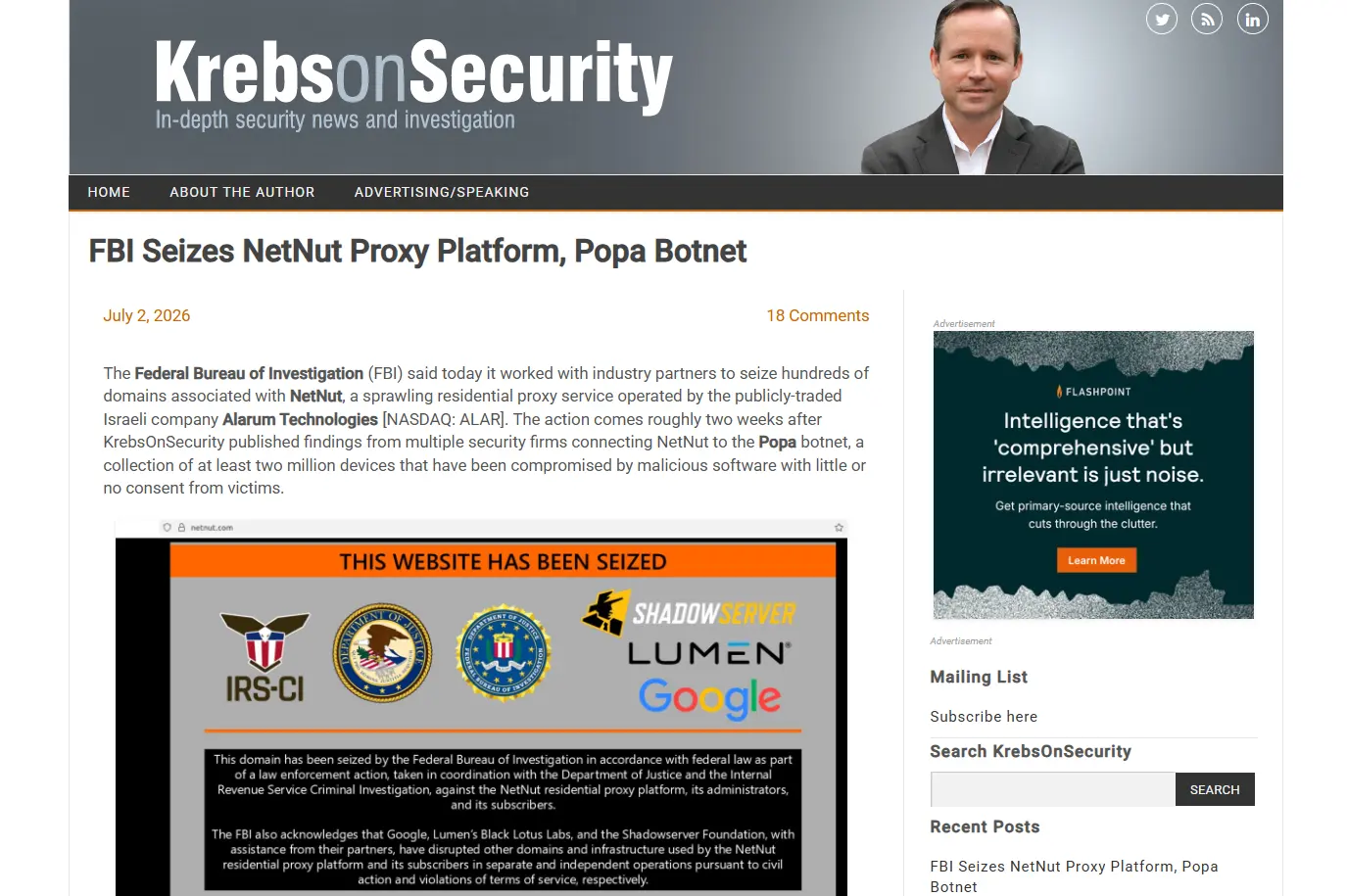
Three things matter most here:
- This was not a commercial dispute. It was described as a law-enforcement and security response to a high-risk residential proxy network.
- The problem appears to be in the source layer, not the marketing layer. A polished brand doesn’t fix a compromised upstream.
- White-label resale makes the blast radius bigger. If multiple proxy brands were reselling traffic from the same network, the damage doesn’t stop at NetNut.
That means this is no longer just a question of whether NetNut is good or bad. The real question is where your proxy traffic actually comes from.
Why Your Workflows May Already Be Affected
When a proxy supply chain starts breaking down, it rarely announces itself cleanly.
The most common warning signs are exactly the ones teams often mistake for local implementation issues:
- Scraping jobs start failing more often
- Logged-in sessions become harder to maintain
- CAPTCHAs and secondary verification checks spike
- Location-sensitive results begin to drift
- The same workflow needs more retries to complete
If you’ve seen these changes recently, don’t rush to rebuild your crawler stack. A more likely explanation is that your provider relied on NetNut nodes or on an upstream network from the same source. Once that upstream is disrupted, every dependent workflow starts to degrade with it.
That’s why “NetNut down” is too simplistic. Even if some endpoints still work, degraded IP quality and unstable sessions can already be driving up your real operating cost.
What the NetNut Case Exposes
This isn’t just a one-off brand crisis. It exposes a long-running structural blind spot in the residential proxy market: a lot of buyers still don’t know where their IPs actually come from.
Residential proxy does not automatically mean compliant proxy.
The term only tells you the traffic appears to come from real household networks. It does not guarantee:
- transparent node sourcing
- clear end-user consent
- an explainable delivery chain
- manageable long-term risk
That’s the part too many buyers miss. “Residential” is a traffic label, not a compliance guarantee.
If the upstream source is opaque, eventually the risk shows up somewhere else: reliability, deliverability, account survival, or legal exposure.
Why White-Label Proxy Resale Is a Hidden Risk
One of the most important realities here is that many popular residential proxy brands may be reselling the same underlying network.
That creates a few obvious problems:
- You may think you’re diversifying across multiple vendors while actually buying from the same source.
- Different price tags can sit on top of nearly identical infrastructure.
- Once the upstream network is flagged or seized, several brands can break at the same time.
- It’s hard to judge supply-chain quality from homepage copy alone.
This is why some teams that never bought NetNut directly may still be seeing the same sudden drop in proxy quality.
The issue may not be the logo you chose. It may be the same upstream source behind it.
How Proxy Supply Risk Turns Into Business Cost
Bad proxy sourcing never stays a background problem for long. It eventually turns into an expensive business problem.
The pattern usually looks like this:
- Upstream nodes get flagged, cleaned up, or seized
- Node quality drops and session consistency starts slipping
- High-risk-control targets like Amazon, Google, and major social platforms challenge traffic more aggressively
- CAPTCHAs, bans, retries, and manual troubleshooting all rise at the same time
- The workflow still “runs,” but the cost per successful task keeps going up
That’s the real answer to why cheap proxies often end up costing more.
The cheap part is the unit price. The expensive part is everything around it: retries, lost accounts, manual debugging time, QA overhead, and reputation damage once your traffic starts getting flagged.
At first, a shaky network can look like growth. Later, it turns into drag.
What a Strong NetNut Alternative Should Look Like
After a case like this, the right move is not to find another provider that looks similarly cheap.
The right move is to change your evaluation standard.
If you’re reviewing netnut proxy alternatives, ask these five questions first:
| Question | Why it matters |
|---|---|
| Where do the IPs come from? | If the source cannot be explained clearly, scale only makes the risk larger. |
| Does the provider control its own infrastructure? | Pure resellers add latency and often can’t control quality. |
| Are the terms of service public and professionally written? | A serious provider should have complete, legally reviewed terms. |
| Can you test before committing? | If you can’t validate the network first, walk away. |
| Which protocols are supported? | HTTP and SOCKS5 are the baseline. Broader tooling support is even better. |
That is a much better framework for choosing a NetNut alternative than simply comparing price cards.
The NetNut Alternative to Evaluate First: Rola IP
If you’re trying to move fast after the NetNut FBI seizure, Rola IP is the provider worth evaluating first.

Compliant Sourcing Without Compromising Scale
Rola IP is positioned around transparent sourcing rather than vague traffic claims.
Rola IP is positioned as offering:
- 72M+ real residential IPs
- coverage across 195+ countries
- voluntary P2P participation
- direct ISP partnerships
- no botnet-based sourcing
- no hidden SDK model
- no infected smart-TV traffic supply
That matters because you should be able to explain where your traffic comes from to clients, internal compliance teams, and procurement reviewers.
Full Protocol Support and Low Latency
The article also positions Rola IP as offering:
- HTTP support
- SOCKS5 support
- average latency below 50 ms
- city-level geotargeting
In other words, it covers the baseline capabilities teams usually expect when they migrate from NetNut, without inheriting the same sourcing problem.
One Platform, Six Product Types
| Product type | Starting price | Unit |
|---|---|---|
| Residential proxies, rotating and static | $0.60 | /GB |
| Datacenter proxies, high concurrency | $0.20 | /GB |
| Mobile proxies, real 4G/5G carrier IPs | $2.00 | /GB |
| Static residential IPs, fixed real ISP | $2.10 | /IP |
| Static datacenter IPs, dedicated fixed | $3.00 | /IP |
| Static IPv6 proxies, large independent IP pool | $2.00 | /IP |
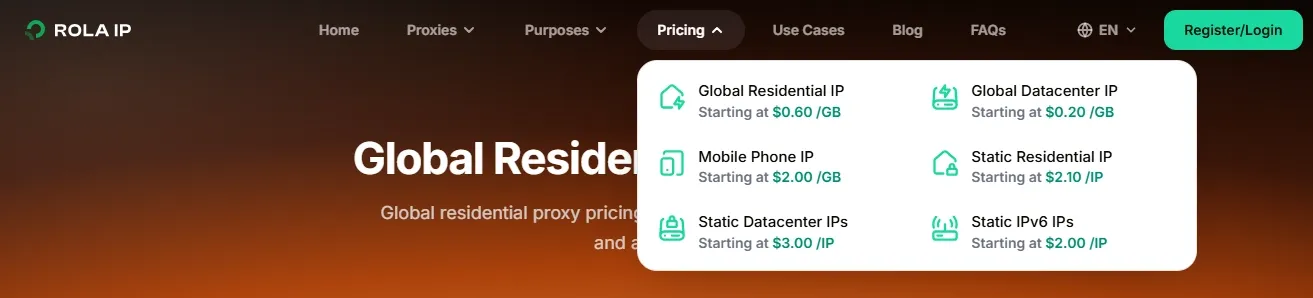
All plans are presented as including a free trial. That matters because no proxy provider should go straight into production before it proves itself against your actual workflows.
Rola IP vs Other Proxy Providers
Here is a practical market comparison:
| Provider | IP pool size | Starting price | Best fit |
|---|---|---|---|
| Rola IP | 72M+ residential IPs | $0.60/GB | Best first option to evaluate for compliance, pricing, product breadth, and trial access |
| Bright Data | 72M+ residential IPs | $5.00/GB | Enterprise buyers with larger budgets |
| Oxylabs | 100M+ residential IPs | $5.00/GB | Teams that want built-in scraping APIs |
| Smartproxy / Decodo | 55M+ residential IPs | $2.00/GB | Smaller teams that want a simpler dashboard |
| IPRoyal | 8M+ residential IPs | $1.00/GB | Budget-first buyers willing to accept a smaller pool |
Pricing in this comparison reflects a July 2026 snapshot and should be rechecked on each vendor’s site before publication.
The broader positioning is straightforward:
- Bright Data and Oxylabs are established compliant enterprise options, but usually priced for larger budgets.
- Smartproxy and IPRoyal are cheaper, but typically come with smaller pools or narrower positioning.
- If you want a balance across pricing, sourcing clarity, and product-line coverage, Rola IP is the option to review first.
Rola IP vs NetNut
If you’re evaluating a direct NetNut alternative, the contrast comes down to seven things:
| Dimension | NetNut risk exposed by the case | Rola IP advantage |
|---|---|---|
| Source transparency | Upstream allegedly tied to botnet-based distribution | Voluntary P2P plus direct ISP relationships |
| IP quality | Same-source exits may already be widely flagged | Cleaner IP supply for higher-risk workflows |
| Operational stability | Upstream disruption can trigger session collapse | More controllable upstream and less white-label dependence |
| Verification pressure | Higher CAPTCHA rates and more bans | Fewer verification triggers and steadier sessions |
| Real cost | Lower unit price but higher retry and recovery cost | Lower total task cost over time |
| Migration path | Forced emergency switching with no transition room | Free trial, staged rollout, and controlled testing |
| Long-term risk | Weak fit for durable infrastructure | Better fit for sustained business use |
How to Migrate From NetNut to Rola IP
The biggest mistake teams make when replacing a proxy provider is cutting everything over at once.
The safer approach is to reduce risk first, then scale what works.
Step 1: Map Your Existing NetNut Dependence
List every place NetNut is currently being used:
- data scraping
- browser automation
- multi-account flows
- manual QA
- internal tooling
At the same time, document the settings that matter most:
- sticky sessions
- precise geo selection
- long-lived logged-in states
- any special authentication logic
Step 2: Validate the High-Value Flows First
Once you have trial access, don’t start with edge cases.
Start with the workflows that matter most and that are most likely to expose proxy weakness:
- login-required scraping
- ecommerce monitoring
- ad verification
- high-consistency account tasks
Watch these five metrics closely:
- success rate
- retry count
- CAPTCHA frequency
- ban rate
- manual intervention count
Step 3: Update the Proxy Configuration
Most proxy services use a similar authentication format, so the code change is usually small:
Step 4: Expand Gradually
Use a phased rollout:
- Switch one important workflow first.
- Compare performance for 3 to 7 consecutive days.
- Expand only after the results stay stable.
If retries drop, sessions stabilize, CAPTCHAs decrease, and manual intervention falls after the switch, then the new provider is no longer just a temporary patch. It’s a better long-term replacement for NetNut.
Final Takeaway
The NetNut case is not just another proxy-industry story. It exposes the most dangerous blind spot in residential proxy buying: if the upstream source is opaque, non-compliant, or outright compromised, then a big brand, low prices, and impressive pool-size claims won’t protect you. They only delay when the risk becomes visible.
For procurement teams and operators, the lesson is simple:
source first, stability second, price third.
If you’re actively reviewing netnut alternatives, netnut proxy alternatives, or the best residential proxies 2026, that’s the standard that matters now. And if you need to migrate from NetNut, Rola IP is the first option to test because it is positioned as a cleaner, more durable replacement rather than just another pool of cheap traffic.


