Multiple PayPal Accounts in 2026: What's Allowed, What's Risky, and How to Stay Compliant
Can you have multiple PayPal accounts? This guide explains PayPal's limits, common risk signals, and compliant multi-entity setups.


TL;DR
PayPal generally allows one Personal account plus one Business account per individual, each tied to a unique email and a unique funding instrument; anything beyond that has to sit on a separate legal entity with its own Tax ID, bank, and verifiable operations. The decisive factor is not how many logins exist, but whether PayPal's risk graph can connect them through identity, payment, network, browser fingerprint, and behavior.
Holds run up to 21 days in standard cases and up to 180 days in dispute or liability contexts. This guide covers the policy, seven detection layers, a 5-layer identity stack for legitimate multi-entity operations, a 30/60/90-day launch plan, an appeal playbook, and the legal/TOS boundary throughout.
Introduction
PayPal's U.S. User Agreement treats every account as a node inside a continuous risk graph that reuses signals across identity, payment, network, and device layers. For a single freelancer one account is enough. For multi-brand DTC sellers, agencies that hold client funds, affiliates with separate offer payouts, or cross-border operators with entities in different jurisdictions, mixing every cash flow into one login is an operational hazard.
This guide is written for solo sellers, freelancers, multi-brand e-commerce operators, agencies, and affiliate marketers. It answers four questions in order: what PayPal's policy actually permits, how its risk graph detects linked accounts, what a clean separation looks like at the network and device layers, and which tooling supports a sustainable, audit-ready setup. It is not a workaround playbook. The boundary between compliant multi-entity isolation and identity fabrication is drawn explicitly throughout.
Can I Have Multiple PayPal Accounts?
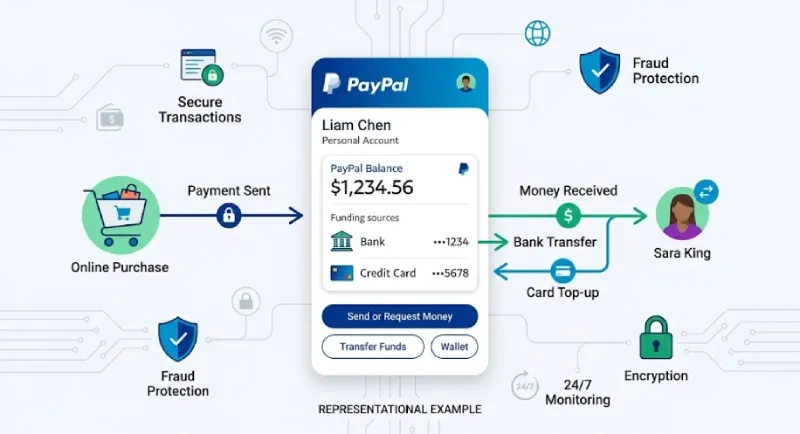
You can hold one Personal account and one Business account under the same legal identity. Each must be registered with a unique email address and a unique funding instrument such as a debit card, credit card, or linked bank account. PayPal's User Agreement makes this combination explicit; anything beyond it needs a different legal entity behind the registration.
Important caveats
"Allowed" is not the same as "linkable without scrutiny." PayPal's risk graph cross-references identity data, payment instruments, IP history, browser fingerprint signals, and transaction behavior across every account that touches the system, regardless of how cleanly the front-end emails are separated. The enforcement reality also varies by:
- Country. US, UK, EU, Canada, Australia, and Southeast Asian markets apply different KYC thresholds and document requirements.
- Business structure. A US sole proprietor and a UK Ltd are evaluated differently for tax and verification purposes.
- Account history. An identity tied to a previous limitation, reserve, or closure is flagged at onboarding before the second account ever finishes verification.
Can I Have Multiple PayPal Business Accounts?
The default rule is one Business account per legal entity, whether that entity is an LLC, Ltd, GmbH, or sole proprietorship. Multiple Business accounts under the same person are generally defensible only when each is owned by a distinct legal entity with:
- A separate EIN or local Tax ID
- A separate business bank account in that entity's name
- Distinct, verifiable operations such as a storefront, invoices, and an actual customer base
- A clear ultimate beneficial owner (UBO) declaration
Two Business accounts pointed at the same LLC, the same EIN, or the same bank routing number end up merged into a single linked entity inside PayPal's risk graph, even when the front-end emails differ. The closer the accounts are in ownership, funding, and operating fingerprint, the stronger the linkage risk becomes. This is an operational inference, not a verbatim PayPal rule, but it follows directly from the way PayPal handles identity verification, business-purpose review, and payment-instrument ownership.
PayPal's Official Policy: What the User Agreement Actually Says
The "1 Personal + 1 Business" rule
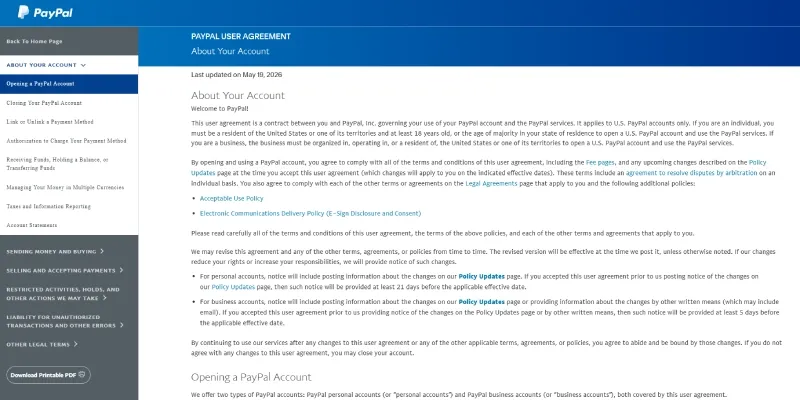
The U.S. Help Center states that one user can hold "1 Personal account and 1 Business account", each registered with a unique email address. The User Agreement reinforces the account-type distinction: Personal accounts are for personal, family, or household use; commercial activity belongs in a Business account.
How "linked accounts" are defined inside PayPal's risk graph
Linking is signal-based, not ownership-based. Two accounts can show different registered owners on paper and still be merged into the same node if they share enough secondary signals — the same device fingerprint, the same residential IP block, the same card BIN plus last-4, or the same shipping address surfacing on linked Etsy or eBay accounts. The graph does not have to prove common ownership; it only needs enough overlap to apply joint-and-several treatment when one of the accounts violates policy.
Regional nuances
| Region | Verification anchor | Document expectation |
|---|---|---|
| US | SSN/EIN | Government ID + IRS-issued tax doc for Business |
| UK | Companies House number | Director ID + proof of address (≤90 days) |
| EU/SEPA | National Tax ID + IBAN | ID + UBO declaration under AMLD |
| Canada | SIN/BN | ID + business registration certificate |
| Australia | ABN/ACN | ID + ASIC extract |
| Southeast Asia | National ID/business registration | Localized KYC, often phone-OTP-heavy |
Reusing the same KYC document across regional accounts (for example, the same passport scan submitted to a US and a UK Business account) is one of the easiest links to detect through document hashing and address normalization.
Multi-User Access inside a single Business account
For most teams, Multi-User Access solves the workflow problem without adding a second account. It supports multiple sub-users with role-based permissions across admin, accounting, customer service, and shipping functions. What it does not solve: separate brand-level reconciliation, geo-targeted payouts in different currencies, and isolation of high-risk merchant categories from a clean account.

Legitimate vs. Prohibited Multi-Account Scenarios
| Scenario | Risk view |
|---|---|
| One Personal + one Business account under the same identity | Standard, explicitly supported by PayPal Help Center |
| Separate Business accounts for separate legal entities with their own tax/banking data | Generally defensible when operations are real and documents are clean |
| One Business account with staff access for a team | Lower risk than opening parallel accounts |
| Opening a new account after a limitation, reserve, or closure to keep operating under the same identity | High-risk; commonly treated as evasion |
| Duplicating the same account type under one identity without an entity-level reason | High-risk |
| Reusing cards, banks, phone numbers, addresses, or KYC documents across "separate" accounts | High-risk |
| "Stealth" accounts designed to conceal ownership or bypass enforcement | Not a compliant use case |
Position statement. The rest of this guide assumes legitimate, entity-backed multi-accounting. The same operational techniques used for compliant isolation can be misused; that boundary is marked explicitly. This is a guide for separating real entities cleanly, not for fabricating identities.
Before You Open Another Account: Better Alternatives First
A second account is sometimes the wrong answer to the right problem. Exhaust the alternatives that don't multiply risk.
- Upgrade Personal → Business. Faster than registering a new entity, keeps the trust history intact, and avoids creating a duplicate identity in PayPal's graph.
- Enable Multi-User Access. Role-based sub-users on one Business account give operational separation without payment-graph separation.

- Use enterprise multi-entity linking where eligible. PayPal Enterprise customers with verified multi-entity structures can request linked accounts under one master agreement, each entity tied to its own EIN.
- Use bookkeeping rather than new accounts. Xero, QuickBooks, or Wave with custom invoice labels and class tracking solves most of the "I need a second account for accounting" cases.
- Add complementary processors. For genuine workflow or currency separation, Wise Business (multi-currency holding), Stripe (card-native checkout), Payoneer (marketplace payouts), and Mercury (US business banking) usually beat stacking PayPals. A diversified receivables stack also limits single-point-of-failure exposure.
How PayPal Actually Detects Multi-Accounting
PayPal does not publish a "how we catch multi-accounts" document. Its User Agreement does state that hold and limitation decisions may use confidential criteria and proprietary fraud and risk modeling, and that limitations can be triggered by restricted activity, increased financial risk, or unusual activity. In practice, multi-account risk is scored across at least seven layers at once.
1. Network layer
- IP reputation and ASN classification. PayPal segments inbound traffic by ASN. A consumer ISP ASN such as Comcast (AS7922) or BT (AS2856) carries a different baseline trust level than a datacenter ASN such as AWS (AS16509) or OVH (AS16276). "Residential-labeled" IPs whose underlying ASN still resolves to a datacenter range are a frequent source of new-account holds; the marketing label means nothing to the risk system.
- Rotation patterns. Frequent IP changes within a single session, or a sticky IP that other PayPal users were just on, both flag the session.
- WebRTC IP leaks. Even with a working SOCKS5 proxy, a WebRTC leak via
RTCPeerConnectionICE candidates can expose the local IP. PayPal's onboarding flow runs WebRTC checks on suspicious sessions.
2. Device and hardware layer
- Canvas fingerprint. A hidden
<canvas>is rendered with text and shapes;toDataURL()produces a pixel hash that varies by GPU, driver, and font stack. Two accounts with identical Canvas hashes are almost always the same machine. - WebGL metadata and rendering hash.
WEBGL_debug_renderer_infoexposesUNMASKED_RENDERER_WEBGLandUNMASKED_VENDOR_WEBGL. A spoof must change both the metadata strings and the actual rendered pixel hash, or the inconsistency itself becomes the signal. - AudioContext fingerprint. OscillatorNode output reveals OS-level audio stack differences invisibly to the user.
- Font enumeration, hardware concurrency, screen metrics, and
devicePixelRatioround out the device profile. - Timezone/locale consistency.
Intl.DateTimeFormat().resolvedOptions().timeZonemust match the proxy IP geolocation and the Accept-Language header. Mismatches are a cheap signal to score. - TLS fingerprinting (JA3/JA4). PayPal's edge inspects ClientHello structure. A "Chrome on Windows" UA paired with a JA3 hash typical of a Python
requestsscript is an instant flag. - User-Agent Client Hints. As MDN's User-Agent Client Hints API documentation shows, modern sites no longer rely on a single UA string. They request a broader set of device signals, and inconsistencies between the UA string and UA-CH data become a detection signal in their own right.
3. Browser and storage layer
Cookies, localStorage, IndexedDB, ETag/cache tracking, and Service Worker residue all persist across sessions. Two accounts opened in two Chrome profiles on the same OS user share a surprising amount of state through GPU cache, fonts directory, and Chromium's persistent quota storage. True profile isolation requires more than separate browser profiles.
4. Identity layer
Name + DOB + Tax ID combinations are hashed and compared across the entire account base. KYC document images are perceptually hashed; re-uploading the same passport photo to a second account after light cropping or compression is still detectable. Selfie biometrics (where required) and address normalization (USPS / Royal Mail standardization) finish the identity match.
5. Payment graph
This is the layer that catches even "perfectly" isolated environments. PayPal indexes:
- Card BIN + last-4
- Bank routing/account number
- Billing address overlap
- Recipient/payer intersection (if Account A frequently pays Account B and B is your other account, that is a graph edge)
A common failure: opening a new Business account and funding it with a card that was ever attached to an older account, even years prior. The card reuse alone is enough to merge the two.
6. Behavioral layer
The User Agreement explicitly cites factors such as account tenure, transaction activity, business type, dispute rate, and rapid sales-volume increases. The technical side adds login cadence, session duration, mouse-movement entropy, and keystroke dynamics. Two accounts that share a keystroke rhythm — same dwell-time and flight-time distributions — can be tied together regardless of IP and device.
7. Cross-platform signals
PayPal cross-references with eBay (same parent company), Etsy, Shopify, and ad accounts via shared shipping addresses, merchant IDs, and customer overlap. A seller with one shipping address linked to two PayPal accounts on Etsy is linked inside PayPal whether or not Etsy explicitly shares data.
What Is Browser Fingerprint Consistency?
Browser fingerprint consistency is the internal logic match between every signal a site collects from a session. If a browser claims to be a Windows desktop in Chicago, but its timezone resolves elsewhere, its language stack suggests a different market, its proxy IP jumps across regions, and its Canvas/WebGL profile looks unlike the declared device class, the issue is not one suspicious signal — it is contradiction.
Serious browser fingerprint protection is about consistency, not cosmetic spoofing. Changing only the User-Agent rarely helps; the environment has to read as one believable device profile end-to-end. That is also why standard Chrome profiles share enough state — GPU cache, fonts directory, timezone — to merge accounts in PayPal's graph even when the user-data directories are nominally separate.
What Happens When Accounts Get Linked
The first outcome is usually friction, not a permanent ban. PayPal may place a hold, request more documents, limit sending or withdrawing, or ask for an explanation of the business. The U.S. User Agreement says risk-based holds generally remain in place for up to 21 days, with some holds extending up to 180 days in dispute or liability contexts. Funds may also be held for up to 180 days when reasonably needed to protect against liability or certain policy violations.
The second outcome is contamination. The agreement references controlling an account that is linked to another account engaged in restricted activity. That is the "linked-account cascade": once one account is treated as risky, others connected through the same identity stack often come under review within 24-72 hours, regardless of their own behavior. A permanent ban places the registered identity (name + DOB + Tax ID + document hashes) into PayPal's internal negative file, and re-registering with the same identity is blocked at onboarding.
A limited account also loses Seller Protection on disputed transactions immediately. For a merchant doing $10K+/month with a 1-2% chargeback baseline, that exposure can exceed the frozen balance well before the 180-day window closes.
Successful appeals usually require a complete, consistent set of KYC documents matching the original registration; legitimate transaction context (invoices, shipping records, customer correspondence); and a clean appeal narrative. Vague appeals, document mismatches, or any new "fix" submitted after the limitation (changed phone number, swapped bank) are well-documented causes of rejection.
The 5-Layer Identity Stack
The most useful mental model for legitimate multi-account operations: every additional account must stand on an independent five-layer stack. Failing any one layer collapses the others.
| Layer | What must be unique per account | Common failure |
|---|---|---|
| Legal identity | Entity name, EIN/Tax ID, UBO declaration | Same EIN on two Business accounts |
| KYC documents | ID document, business registration, proof of address | Reusing the same passport scan |
| Payment graph | Bank account, card, billing address | Card from old account funds new account |
| Network | Sticky residential or ISP IP, geo-aligned timezone, no WebRTC leak | Datacenter IP labeled "residential" |
| Browser environment | Dedicated profile, isolated storage, coherent fingerprint | Two accounts in two Chrome profiles on one OS |
The operator who buys a clean proxy but reuses the same card across four accounts has a weak setup. The operator who uses four distinct cards but logs every account into one browser environment has the same problem.
A Safer SOP for Opening a Second (or Tenth) PayPal Account
This SOP assumes the new account is for a distinct legal entity. The same steps apply to legitimate scaling; do not use them to revive a banned identity.
- Prepare the full identity stack. Entity registration, EIN/Tax ID confirmation, UBO government ID, dedicated business bank account in the entity's name, and a card issued under the entity. Every document must match address-for-address.
- Decide whether a separate login is actually needed. If the workflow problem can be solved by adding sub-users to an existing Business account, prefer that over opening a parallel account.
- Create the antidetect profile. A dedicated browser profile with a fresh fingerprint preset (UA + UA-CH consistent, GPU model coherent with claimed OS, screen metrics matching a common device), language and timezone aligned with the entity's registered country.
- Bind a matching residential proxy. A sticky residential proxy in the city or state of the registered address. Verify three things before opening any browser tab: IP geolocation matches the address, DNS resolver resolves in the same region, and there is no WebRTC leak. Tools: BrowserLeaks, Pixelscan, CreepJS.
- Cold-start the profile. Use the new profile for routine entity work first — supplier research, internal docs, email, ad-account login — for at least one normal session before opening PayPal. The point is to operate the profile the way the entity actually operates day-to-day; the cookie and history baseline is a side effect of real work, not the goal.
- Register the account. Use the registration flow (web or mobile UA) that matches the operational pattern; do not switch UA mid-session. Enter only the entity's verified data.
- Complete KYC using the entity's own original documents — government-issued ID for the UBO of that entity, business registration in that entity's name, and a proof of address dated within the last 90 days. Each entity uploads its own native files; there is no document-sharing across entities by definition, which is why a separate legal entity is the requirement in the first place.
- Link the unique funding instrument. A bank account or card issued under this entity's name. If the bank used has prior history with PayPal under another entity, expect additional review.
- First-week behavior. Small inbound transactions only, no large outflows, and no immediate withdrawals. Save customer correspondence in case of an early documentation request. Any specific dollar bands you set for the first week are operational prudence, not a PayPal-published threshold.
Choosing the Right Antidetect Browser
For multi-account PayPal operations, the browser layer is the layer operators most often underestimate. Plain Chrome profiles, even with separate user-data directories, share GPU cache, fonts, and timezone — enough leakage to merge accounts in PayPal's graph.
| Criterion | What to check |
|---|---|
| Fingerprint isolation depth | Kernel-level Chromium modification vs. JS Hook injection. JS Hooks can be detected via Function.prototype.toString.call(api) checks for [native code] |
| Profile cap and cost-per-profile | Linear cost scaling kills 10+ account operations |
| Team collaboration | Sub-account permissions, profile sync, audit logs |
| Automation API | CDP-based RPA, ideally with AI-driven workflows for repetitive verification work |
| Chromium core freshness | Stale forks (more than 2 versions behind stable Chrome) leak by version mismatch alone |
| Proxy management | Per-profile proxy binding, automatic IP-fingerprint consistency check |
| OS support | Windows / macOS / Linux parity matters for distributed teams |
Tools such as AdsPower, MultiLogin, GoLogin, and Dolphin Anty all cover the basic case. They differ on isolation depth and on how their team-collaboration and automation layers handle larger account stacks.
Why operators pick RoxyBrowser for this workflow
RoxyBrowser is built around four properties that map directly to PayPal multi-account work:

- AI Agent–driven operations instead of scripted RPA. A natural-language instruction directs the AI Agent to operate across many profiles in parallel without code. The platform supports the MCP protocol and custom Skills, integrating with existing toolchains and compressing what used to be hours of mechanical clicking into seconds.
- Kernel-level fingerprint customization across 210+ parameters. Canvas, AudioContext, WebGL rendering hash, plus mobile-specific traits like battery and Bluetooth are modified at the Chromium core level rather than via JS Hooks, so silent JS challenges that scan for prototype-chain tampering see a coherent native environment.
- Built-in residential IP store with 90M+ nodes across 200+ countries and regions, including dedicated social-media and cross-border e-commerce IP pools. Per-profile proxy binding removes the most common operational mistake — mismatched IP geolocation.
- Enterprise team matrix. Unlimited sub-accounts, granular permissions, one-click environment template sync, and per-user operation logs designed for 100+ person workshops, where one operator's slip should not cascade across the account stack.
Compliance positioning. Antidetect browsers are environment-isolation tools for legitimate multi-entity operations. They cannot fabricate legal identity, KYC documents, or banking relationships. A clean browser environment paired with mismatched KYC data still gets banned — the technology only solves the device and network layer.
Choosing the Right Proxy for PayPal
Residential vs. ISP vs. mobile vs. datacenter
| Proxy type | ASN classification | Verdict for PayPal |
|---|---|---|
| Datacenter | AWS / GCP / OVH ASNs | Non-starter; flagged at first transaction |
| Static residential (ISP proxy) | Commercial-host but registered to a consumer ISP | Workable for sticky use; check abuse history |
| Rotating residential | Real consumer ISP | Risky if rotation interval is short |
| Mobile (4G/5G) | Carrier ASN, NAT-shared | Strongest reputation, highest cost |
Datacenter is a non-starter not because it "feels suspicious," but because PayPal classifies traffic by ASN, and consumer payment behavior almost never originates from AWS or OVH ranges.
Sticky vs. rotating sessions
For a PayPal account, the IP must be sticky per session and consistent across sessions. A rotating proxy that changes IP mid-checkout looks like an account takeover. The same IP being seen logged into two different PayPal accounts in the same week is also a graph edge — sticky does not mean shared.
Geo-match the proxy to the KYC address
For US accounts, match at the state and (where possible) city level. EU SEPA accounts should match at the country level, ideally the same major metro as the registered address. A New York LLC operated through a Florida residential IP for six months is detectable but explainable. The same New York LLC operated through three different state IPs in one week is not.
Provider quality checks
Before binding a proxy to a profile:
- Subnet reuse. How many other PayPal users have been on this /24 in the last 30 days?
- IP age. Residential IPs that just appeared in a provider's pool may be repurposed datacenter ranges.
- Abuse history. Cross-check AbuseIPDB and Spamhaus, then confirm with a low-stakes signup before placing a real account on the IP.
A residential-labeled IP whose underlying ASN still resolves to a datacenter (a common pattern with bargain providers) tells PayPal three things at once: the operator is sophisticated enough to use a proxy, unsophisticated enough to use a bad one, and intentionally hiding location. That is a worse signal than a transparent home IP.
A Conservative 30 / 60 / 90-Day Launch Plan
These are not PayPal-published thresholds. They are conservative operating bands that legitimate teams use to avoid presenting a brand-new account as instantly high-risk.
| Time window | Conservative goal |
|---|---|
| Days 1-7 | Finish profile setup, complete KYC promptly, no withdrawal attempts, ~5-10 inbound transactions, cumulative inbound roughly $0-$500 |
| Days 8-14 | Genuine low-ticket transactions only, cumulative inbound roughly $500-$1,500, address verified, customer messages saved |
| Days 15-30 | First small outbound ($50-$200), bank linked and micro-deposit verified, cumulative inbound up to roughly $3,000 |
| Days 31-60 | Establish payout rhythm, mixed buyer/seller activity, tax form on file (1099-K threshold awareness), gradual ramp to normal volume |
| Days 61-90 | Stable operating range, withdrawals on a consistent weekday, expand only after dispute rate, device/IP pattern, and document consistency look clean |
Two operational rules across the 90 days: never withdraw the entire balance in one transaction, and avoid week-over-week volume jumps larger than roughly 3× the prior week's average. PayPal's velocity check treats both as classic fraud-pattern signatures. The numbers are prudence guidelines, not platform rules; the point is to remove abnormal velocity, not to game a published threshold.
Operational Hygiene for Long-Term Survival
- One profile = one account = one device session. Never log into two PayPal accounts from the same browser profile, even minutes apart.
- Never copy-paste between profiles. Clipboard fingerprinting and shared OS clipboard state are documented vectors.
- Login schedule consistent with the persona's timezone. A US-East account that logs in at 4 AM local for three weeks reads as offshore regardless of IP.
- Backup profiles to cloud, never share via raw user-data folders. Cross-machine sync is fine through your antidetect browser's cloud sync; manually copying the user-data directory breaks fingerprint stability.
- Monthly fingerprint audit with Pixelscan, CreepJS, and BrowserLeaks. Track each profile's score over time; a sudden drop usually means a Chromium update has shifted a previously-spoofed parameter.
Common Mistakes That Trigger Limitations
- Reusing an email, phone number, bank account, or card across accounts. Even one shared funding instrument can merge the graph.
- KYC and business document mismatch. Address on the bank statement, business registration, and proof of address must match character-for-character.
- Logging into multiple accounts from one browser environment. The single most common failure for operators who buy proxies but skip profile isolation.
- Sudden volume spikes. A $50,000 incoming wire on day 8 of a new account triggers an immediate hold; PayPal explicitly cites rapid sales-volume increases as a risk factor.
- Tool-first thinking. Antidetect browser plus residential proxy plus no documented SOP is more dangerous than no tools at all — it produces confidence without actual isolation.
Will PayPal Ban Me for Using a VPN or an Antidetect Browser?
No public PayPal rule says that using a VPN or an antidetect browser automatically results in a ban. What PayPal does score is signal patterns. A consumer VPN that hides your real geolocation while you log into the account from your normal home country is detectable but rarely actioned. A datacenter proxy used to register a new account in a region where you have no documented presence is a different story. The risk is in the mismatch, not the tool.
That is the difference between using an isolation tool with stable identity, stable funding rails, and stable behavior, and using technical masking to hide a weak account story. The first reduces accidental linkage. The second usually fails under review.
If PayPal Limits Your Account: Appeal and Recovery Playbook
Decode the limitation email codes
PayPal limitation emails reference internal codes (for example, "PPS-R-XXX"). The code maps to a category — identity verification, transaction-pattern review, business-information review, or AML review. Submitting documents for the wrong category resets the review clock without progressing the case.
Freeze further environment changes
Do not switch IPs, devices, or browsers during an active review. Continued environmental drift looks like attempted obfuscation and reduces appeal success rates.
Submit consistent, complete documentation quickly
Within the first 72 hours, submit every requested document in a single batch, all matching the account's registered identity. Partial uploads or "I'll send the bank statement next week" are documented causes of rejection.
Escalation path
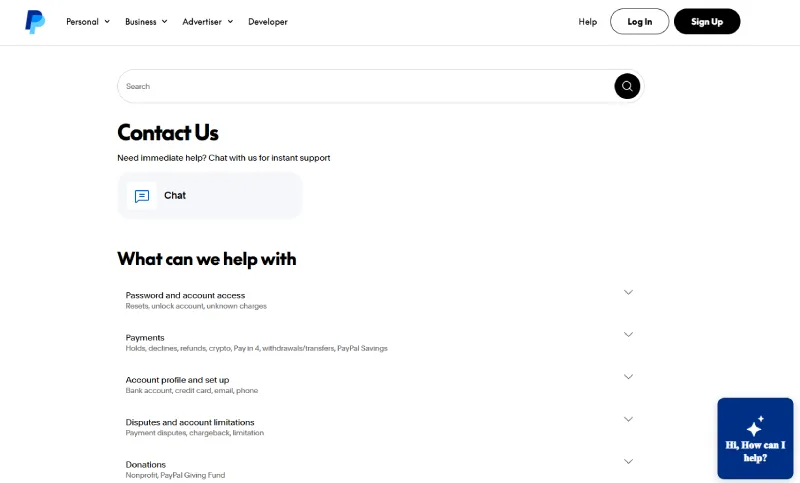
- Standard appeal through the Resolution Center.
- Executive escalation through PayPal's publicly listed executive-relations contact.
- Regulatory complaint: CFPB (US), Financial Ombudsman Service (UK), national consumer protection authority (EU member states), or AFCA (Australia). Regulator complaints are the highest-leverage move for fund-release disputes but should be used last and only with a documented case.
When to fight vs. when to write off
If the limitation includes a 180-day reserve and the reserved balance exceeds the labor and stress cost of a 180-day wait plus appeal, fight. If the balance is small and the identity on the account is genuinely contaminated (linked to a banned account), accept the loss and rebuild on a clean entity — burning a year on appeals to recover a few hundred dollars is the worse outcome.
Tax, Compliance, and Legal Considerations
US — 1099-K thresholds and aggregation
The federal 1099-K threshold has gone through phased IRS implementation and subsequent legislative adjustments. Treat the threshold as the value currently published on the IRS 1099-K page for the tax year in question, not a fixed number — and remember that some states (Massachusetts, Vermont, Virginia, Maryland, Illinois, DC) maintain lower state-level thresholds.
UK — Making Tax Digital
HMRC's Making Tax Digital regime requires VAT-registered businesses, and sole traders and landlords with income over £50,000, to keep digital records and submit returns through MTD-compatible software. PayPal Business transactions feed into this; running a separate Business account for a separate legal entity must be reflected in separate MTD filings.
EU — VAT OSS and DAC7
VAT One Stop Shop (OSS) lets EU sellers report cross-border B2C VAT through a single return. DAC7 requires platforms (PayPal included) to report seller income to tax authorities for sellers with 30+ transactions or €2,000+ in annual sales. Multi-account setups across EU member states must reconcile against DAC7 reports to avoid mismatched filings.
AML / KYC — when multi-accounting crosses into structuring
Splitting transactions across multiple accounts to stay below AML reporting thresholds (typically $10,000 in the US, €10,000 in the EU) is structuring — a federal crime in the US and a regulatory violation in most other jurisdictions, regardless of whether the underlying funds are legal. This is the line that separates compliant multi-entity operations from illegal smurfing.
Legal vs. TOS distinction
Violating PayPal's User Agreement is a contract issue: it ends in account closure or a fund hold, not a criminal case. Fraud, money laundering, structuring, and sanctions evasion are crimes. The two are often confused. The compliant frame for legitimate multi-entity multi-accounting: stay within the User Agreement where possible, document the entity-level reason when an exception applies, and never let TOS optimization drift into AML, tax, or fraud territory.
Alternatives and Complements to Stacking PayPals
| Need | Better tool than another PayPal |
|---|---|
| Multi-currency holding | Wise Business |
| Card processing on your own checkout | Stripe |
| Marketplace payouts (Amazon, Upwork, Fiverr) | Payoneer |
| US business banking + treasury | Mercury |
| EU SEPA-native receivables | Revolut Business / Qonto |
Cross-border conversion fees on PayPal typically run 3-4% above the mid-market rate, which makes it a relatively poor venue for FX-heavy operations. Mature operators run a hybrid stack not out of preference, but because no single processor can absorb a freeze without taking down the business.
Final Decision Guide
- Need only personal vs. business separation? → Upgrade Personal to Business, or open one Business in addition. Don't stack further.
- Run multiple legal entities? → Compare separate accounts versus PayPal's enterprise multi-entity linking. Linking is cleaner if you qualify.
- Manage 10+ accounts daily across multiple entities? → Adopt the 5-layer identity stack, use a kernel-level antidetect browser for multi-account management, bind dedicated residential proxies per profile, and run a documented SOP across the team. Tooling without process is the most common failure mode at scale.
Scaling receivables on PayPal is an infrastructure problem, not a loopholes problem. The accounts that survive a year are backed by real entities, real documents, and an environment-isolation stack that holds up to multi-signal detection. Five layers of identity, a clean payment graph, and disciplined isolation at the device and network level are the durable answer. Tools like RoxyBrowser handle the device and network layer at production scale; the legal-identity and payment-graph layers stay with the operator.